

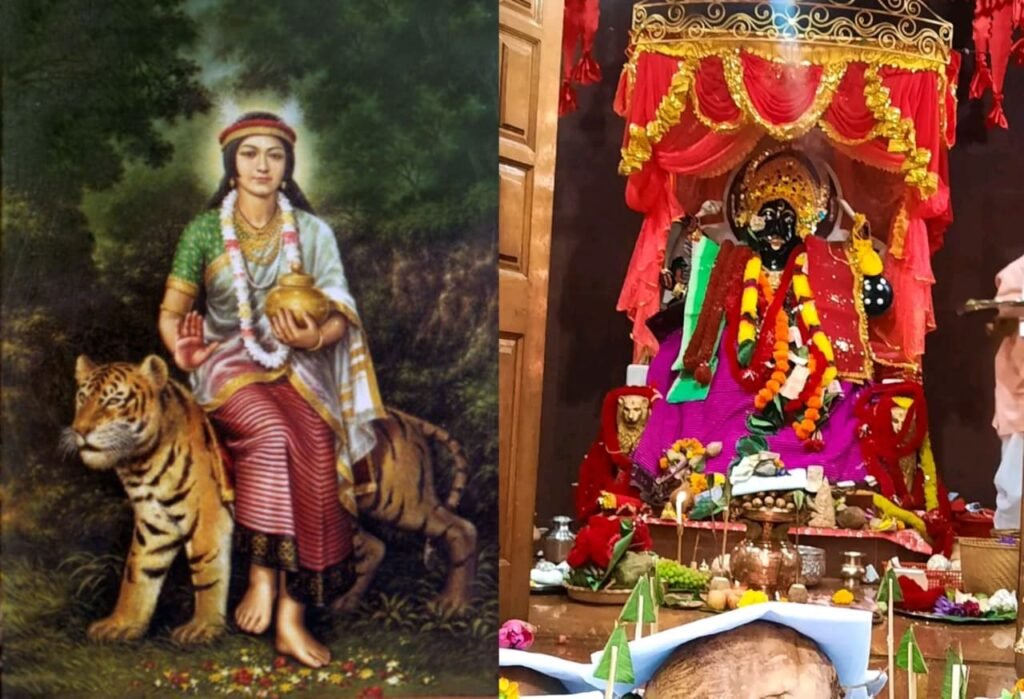
The month of Mera is indeed a festive month in Manipur. The first festival celebrated during this month is Mera Chaorel Houba, marking the beginning of the Mera month. A few days later, from the seventh day, two vibrant festivals begin – Durga Puja and Panthoibi Iratpa, with the latter literally being the worship of Goddess Panthoibi. If you’re born and brought up in Manipur, you’re likely to perceive Goddess Durga and Goddess Panthoibi as the same goddess with different religious affiliations. You’ve probably heard people say, ‘Goddess Panthoibi is the Meitei version of the Hindu Goddess Durga.’
This article aims to investigate the above claim that Goddess Panthoibi is the Meitei equivalent of Durga, tracing its origins and evaluating the accuracy of this assertion.
Early Beginnings:
The first evidence of Durga worship in Manipur dates back to 1707, when the Cheitharol Kumbaba, the Royal Chronicle, recorded the construction of a ‘Kali temple’ by King Charairongba, the first Hindu king of Manipur. However, the temple collapsed the following year for unspecified reasons. In 1716, it was rebuilt by his son, Garib Niwaz (also known as Pamheiba). This indicates that Durga worship was already established in Manipur by the early 18th century. Notably, Kali/Durga was not yet identified with Goddess Panthoibi, who appeared as a distinct Meitei deity in 1708 AD. Furthermore, this identification is also absent in the seminal book, Panthoibi Khonggul.
Hiyangthang Lairembi and Durga:
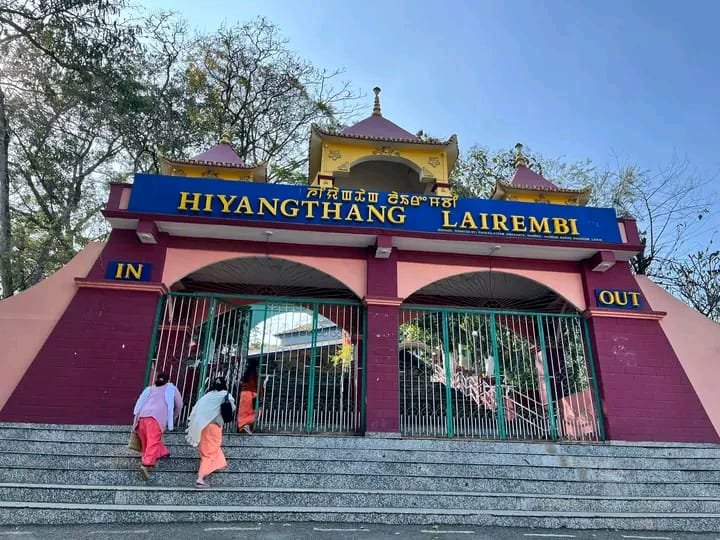
The main temple of Durga worship in Manipur is located in Hiyangthang, six miles south of Imphal. While the temple’s origins are rooted in the traditional Meitei worship of a lai, over time, the deity became identified with Durga.
However, this identification was not always the case. Prior to being associated with Durga, Hiyangthang Lairembi was identified with Kamakhya, as evident from the court chronicles. The identification with Durga is attributed to the 1850s, during Chandrakirti’s reign.
According to Saroj Nalini Arambam Paratt, “By 1855 AD, Hiyangthang Lairembi had become identified with Durga and was receiving the Hindu puja of the milk of one hundred and eight cows.” Notably, this period also saw an increase in information about the worship of Shiva in Manipur.
It’s also worth noting that the two goddesses bear little to no resemblance to each other. Hiyangthang Lairembi, also known as Irai Leima, is attributed with qualities of peace and graciousness. This is evident in the following prayer attributed to Irai Leima by her worshippers:
“O Mother, thou art merciful. Be gracious and forgive our sins. Drive away passions and desires that destroy the purity and calmness of our heart. Through thy profuse grace, may we live in peace.”
At present, the Hiyangthang Lairembi temple draws worshippers from all corners of the state during the annual Durga Puja festivities, particularly on ‘Bor Numit’ (Boon Day), when devotees believe the goddess blesses every person who worships her.
Panthoibi and Durga:
There’s no denying that the identification of Panthoibi with Durga is a relatively recent phenomenon. Although the motive behind this remains obscure, it’s possible to trace the origins of this identification with the help of some sources.
One such source is Lt. Col. John Shakespeare’s book, ‘Religion of Manipur‘, which states, ‘These two deities are gradually becoming identified with Durga and Mahadev of the Hindu pantheon.’ The two deities mentioned here are Panthoibi and Nongpok Ningthou, respectively. Given that this was written in 1913, it’s clear that the process of assimilation had begun around that time. However, the complete merging of the two goddesses into one is a more recent development.
Another source, Saroj Nalini Arambam Paratt’s ‘Religion of Manipur’ (1980), notes, ‘The question of Panthoibi’s identification with Durga is much more recent, and the motives behind it are obscure.’ This suggests that even by the 1980s, the process had not yet reached its culmination, leaving the author with doubts about the identification.
What could have been the basis for this identification? While the exact reasons remain unknown, we can speculate on some probable factors. One possible reason is the ‘greatest goddess’ factor, where Panthoibi, being the most revered goddess in the Meitei pantheon, was naturally identified with Durga, the prominent goddess in Hinduism. This perspective is also mentioned in both the sources cited above. Another possible reason could be the forcible attempt to ‘hinduize Manipuri traditional gods, which may have led to the syncretization of Panthoibi with Durga.’¹
Possible Chronology:
Based on the analysis of the above points from various sources, the following chronological order seems plausible for Durga worship in Manipur:
- Durga worship was introduced in Manipur by King Charairongba, with a Kali temple built in 1707. At this point, Durga was a distinct goddess, and no identification with either Hiyangthang Lairembi or Panthoibi had occurred.
- Hiyangthang Lairembi was identified with Assam’s Kamakhya, reportedly during Garib Niwaz’s reign, according to popular belief.
- Hiyangthang Lairembi was identified with Durga during the 1850s, during King Chandrakirti’s reign.
- The process of identifying Panthoibi with Durga began in the early 20th century, with the probable reasons discussed above.
- The current situation presents a paradox. While followers of Sanamahism deny Panthoibi’s identification with Durga, the Panthoibi Iratpa festival coincides with Durga Puja, and the festivities share similarities. This contrasts with the traditional view of worshipping Panthoibi during the Lamta tha, rather than the Mera tha when Durga Puja is celebrated.
Conclusion:
Having explored the claim that Goddess Panthoibi is the Meitei equivalent of Goddess Durga, including its origins, we invite readers to draw their own conclusions about the accuracy of this assertion based on the evidence presented.
References:
- Lt. Col. john Shakespeare: The Religion of Manipur (1913)
- 2. Saroj Nalini Arambam Parratt: The Religion of Manipur (1980)
- Shree Sapam Bheigya: A Brief History of Manipur.

Daniel Yumkham | Film Critic and Researcher
Passionate about history and Manipuri culture, Daniel shares film reviews and research on:
-Manipuri Cinema (Instagram : thefilmdiary )
-Regional History and Traditions.